





If you lead consumer marketing, digital growth, or Customer Value Management (CVM) at a telecom operator, you recently pushed a major capital allocation past the board. You secured budget to modernize your CVM stack and fund real-time personalization engines, predictive churn models, and automated campaign decisioning layers.
Now, accountability arrives.
Your Chief Financial Officer or Chief Commercial Officer asks the one question you knew was coming: for every dollar poured into CVM models and real-time engines, how much incremental ARPU or subscriber retention did it actually create?
When that question hits the table, telecom organizations immediately split into two distinct camps:
- Camp A (Covers The 88% Majority): Your subscriber journeys feel active. Teams show off campaign click-through rates, high offer uptake, and peak output from personalization engines. Yet, isolating pure incremental ARPU or saved churn from seasonal recharge patterns, network upgrades, or parallel tariff promos remains impossible. You rely on rough proxies and quiet budget anxiety during quarterly reviews.
Camp B (Covers The 12% Minority): You enter the boardroom armed with mathematically defensible proof. You skip efficiency proxies entirely. Instead, you present verified ARPU lift and saved subscriber value generated through controlled A/B holdouts, mapped directly against a fully audited CVM cost base.
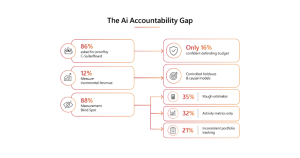
Data from the Comviva Global CMO Survey Report 2026 highlights the reality. Eighty-six percent of marketing leaders faced board pressure to justify AI spending over the past year. Only 16 percent feel confident defending their current allocation. Worse still, only 12 percent measure incremental revenue using controlled methods. That equals fewer than one in eight enterprises.
The gap between investing in AI and proving its business value is not caused by a lack of intelligence or ambition. It stems from a structural breakdown in measurement.
Why Is Measuring AI ROI So Hard?
Traditional frameworks like standard ROI, ROMI, or static attribution fail here. They were built for discrete campaigns with fixed dates. Always-on AI systems break those assumptions completely.
Organizations hit three major structural traps:
- Cost Fragmentation (62% struggle here): Operators track software licenses or API fees while missing underlying expenses. For every dollar spent on propensity model development, telcos spend three dollars on cloud compute and network infrastructure charges, such as processing real-time network QoE signals, alongside specialized data science talent and legacy BSS/OSS system integration.
- Revenue Attribution Complexity (58% struggle here): Algorithmic systems touch every subscriber touchpoint across a complex journey, such as a real-time data exhaustion alert via SMS, followed by an in-app booster recommendation and a USSD recharge prompt. Traditional models over-credit AI by counting the same subscriber interaction multiple times.
- The CX-to-Revenue Disconnect (55% struggle here): CVM teams struggle to connect live customer experience signals, from a dropped call network event to a service request or a failed recharge, directly to financial outcomes. When improved network quality of experience or proactive service recovery cannot be linked to lower churn or higher subscriber lifetime value (CLTV), these critical touchpoints look like pure operational overhead during budget cuts.
High performers do not succeed because they possess superior algorithms. They succeed because they install disciplined measurement habits.
Five Habits of the 12%
When the survey compared organizations that can prove AI’s revenue impact with those that can’t, five habits showed up consistently. These aren’t abstract best practices; they’re specific, observable choices.
Here are the five operational habits that separate the 12% who can prove AI ROI from the 88% who cannot.
Pattern 1: CFO-CMO Alignment Starts With the Telecom Budget
In top-performing telecom organizations, establishing AI ROI is not treated strictly as a marketing analytics exercise. It is governed as a shared financial contract between the CMO and CFO governing modern CVM spend and network AI investments.
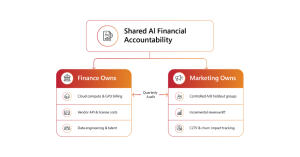
The split is explicit, agreed upon beforehand, and audited on a quarterly cadence:
- Finance owns total cost capture: They track software licensing, cloud compute for real-time network AI processing, API token consumption, specialized data science talent, and legacy BSS/OSS integration overhead across IT, network, and commercial budgets.
- Marketing owns incremental revenue attribution: They design scientific holdout groups and causal models to isolate pure ARPU growth, bundle upsells, and churn reduction.
Because both leaders agree on the CVM cost denominator and the incremental revenue numerator before capital is deployed, budget defenses disappear. The C-suite receives an audited figure rather than a subjective marketing deck.
Pattern 2: They Measure One Initiative Perfectly Before Scaling Across the Portfolio
When organizations attempt to establish portfolio-wide AI attribution from day one, confidence in their numbers collapses. The 12 percent of high performers do the opposite: they pick a single, high-impact flagship use case and subject it to total measurement rigor for at least 12 months before expanding.
According to the Comviva survey, high performers focus their initial measurement efforts on the top three revenue-generating AI use cases:
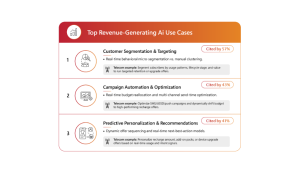
By subjecting a single flagship, such as AI-driven micro-segmentation for 5G upgrades or real-time data booster recommendations, to full cost accounting, randomized control groups, and quarterly tracking, the organization builds an auditable blueprint. Once proven, that measurement template is rolled out across secondary lifecycle journeys.
Pattern 3: Capital Moves Toward Proven Efficiency, Not Momentum
In average telco marketing operations, AI budgets are allocated annually based on team requests, vendor hype, or strategic momentum. In high-performing teams, capital allocation is fluid, systematic, and tied directly to breakeven thresholds for subscriber acquisition and retention.
Leading marketing organizations routinely execute a systematic reallocation of 20% to 30% of their total AI budget annually.
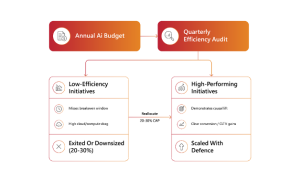
Rather than letting underperforming churn prediction models or chatbot pilots quietly consume cloud compute and maintenance bandwidth, leaders establish clear operational horizons. If an initiative fails to reach its breakeven threshold within an agreed timeframe, its capital is reclaimed and directed toward proven high-yield campaigns like automated recharge stimulation.
Pattern 4: Governance Is Treated as Insurance
A common misconception among telco executives is that strict governance, compliance checks, and model explainability audits slow down innovation. The data reveals the exact opposite: operators with quarterly governance cycles expand their AI initiatives significantly faster than those without.
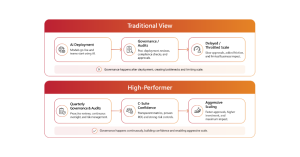
Unchecked AI models create invisible liability risks. A biased recommendation engine that systematically miscalculates price sensitivity and serves sub-optimal recharge offers or discriminatory data pack upgrades, or a churn model that misuses subscriber CDRs and location data in violation of telecom data privacy and sovereignty regulations, erodes subscriber trust faster than it builds ARPU.
High performers view quarterly bias audits, explainability scores, and model governance checks as insurance premiums. Governance provides executive leadership with the confidence required to authorize aggressive scaling without fear of catastrophic reputational damage, legal exposure, or regulatory fines under sector-specific telecom data rules and framework mandates like the EU AI Act.
Pattern 5: Integration Infrastructure Is a Deliberate Investment, Not an Afterthought
You cannot calculate real-time AI ROI if your cost data lives in cloud billing or procurement systems. At the same time, usage, charging, and network signals sit trapped in disconnected CRM, billing, and network analytics systems.
High-performing CVM teams do not attempt to link disparate data retroactively. They recognize that connecting signals across charging, network, and digital channels is the foundational prerequisite for both real-time execution and accurate measurement.
This relies on three connected operational pillars:
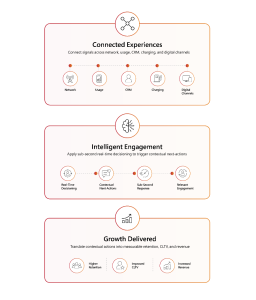
When enterprise platforms unify network Quality of Experience (QoE), recharge habits, device attributes, and channel activity, every subscriber interaction generates a clear data point. By applying sub-second, telco-native real-time decisioning to these connected signals, engagement becomes contextual, timely, and personal.
Most importantly, because the underlying architecture connects the initial customer signal to the eventual financial outcome, measuring incremental lift becomes a natural byproduct of execution rather than an impossible data-reconstruction project.
The Thread Running Through All Five
Provable ROI requires visible connections between customer signals, financial costs, and business outcomes. Every prepaid top-up, network event, data exhaustion trigger, and app session emits a signal.
The operators that can prove AI ROI aren’t necessarily the ones running the most models. They’re the ones who’ve connected the signals well enough to see, in real time, what’s actually working, and disciplined enough to turn that visibility into decisions that compound into measurable ARPU and retention growth over quarters, not just single campaigns.
Moving From AI Enthusiasm to AI Accountability
Over the next eighteen months, a permanent divide will separate optimists from accountable telecom leaders. Because commercial LLMs and algorithms are universally available, technology alone stops being a differentiator.
Success belongs to CVM and commercial leaders who embed measurement discipline into their operating rhythm. They align with finance, master flagship use cases, reallocate capital, and enforce governance.
Platforms built for real-time telco Customer Value Management, such as MobiLytix® Engagement Studio, are increasingly designed with this exact philosophy in mind, combining sub-second event decisioning across network and usage signals with the causal, auditable measurement required to defend business impact in the boardroom.
| To explore the underlying benchmark data, global industry breakdowns, and full methodology, access the complete research: Comviva Global CMO Survey Report 2026: The AI Efficiency Divide. |