




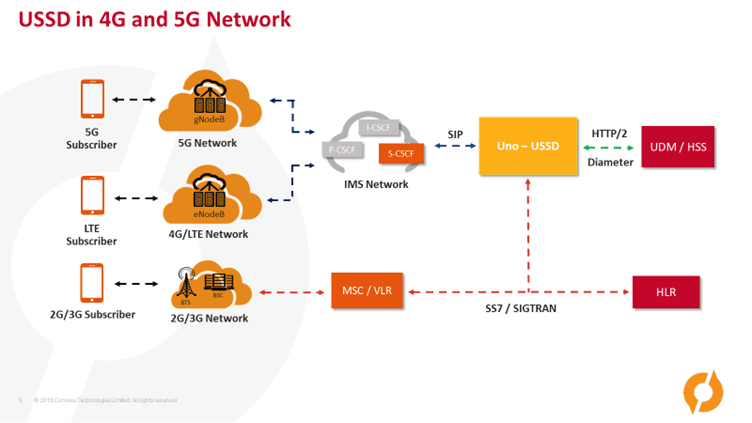
Over the past few decades, USSD technology has carved its own space in the telecom industry. It has enabled a gamut of services, such as mobile banking, customer services, etc. With higher internet speeds enabled by newer technology, such as 4G or 5G, other alternatives like application development which can work directly from smartphone to a domain on internet, are a possibility.
However, USSD service is still required in even in pure 4G and 5G networks, because:
- USSD is one of keyway to reach the subscriber
- When the subscriber’s data pack is exhausted, USSD is still required for banking , other services, etc.
In 4G and 5G networks, we don’t need a similar complex or bulkier solution for USSD. On IMS, like many other application services run, USSD can also be provided. With this approach all other underlying fundamentals of IMS can be leveraged, like using SIP as protocol for signalling, et all.
In fact, 3GPP Specs 24.390 Version 11 talks of providing USSD-like services on IMS, known as USSI (USSD Services on IMS).
Also, an upgraded version 15 of same specs highlights the same or a similar solution on 5G using IMS. Depending on network architecture, the interface geared towards HSS/UDM to fetch information shall be different on 4G and 5G networks. However, access towards UE shall remain the same.
At a very high level, this solution enables subscribers to access USSD services directly from the attached LTE/5G/IMS network and provides a similar user experience as in GSM. For the operator, it will not be a big investment, as all it needs a new application server to be added onto their network which can be either stand alone or with functionality upgraded in services that are already operational. This investment in USSD is future proof as well, as it holds true for 4G and 5G too.