



In retail banking and lending, time is money. Experts estimate that nearly 30–40% of early-stage delinquencies (such as a missed credit card payment or loan EMI) could be recovered if the customer is contacted immediately. After just 48 hours, however, the odds of recovery drop off a cliff – and the cost of collecting that debt can skyrocket (some banks report costs multiplying 5x or more). So why do so many banks still let this window slip by?
Here’s the all-too-familiar example: a borrower misses an EMI payment. Day 1: at 10am, an automated SMS reminder is sent – but it never gets read. Day 2: an email follow-up goes out (languishing unopened). By Day 3: a call center agent finally dials the customer, only to catch voicemail or gatekeeper “they’re busy” excuses. At that point (~36+ hours later), the chance of payment has already shrunk. The customer may have meant to pay, but the timing and channel didn’t align with their behavior.
This “wrong channel, wrong time” scenario is all too common. A McKinsey study found that delinquent customers overwhelmingly prefer to be contacted via email or text message, especially early in delinquency. Yet lenders still default to calls and letters, especially as days pass. The result is predictable: by ignoring preferred channels, banks force customers into inconvenient conversations, often pushing them further from paying. In fact, McKinsey reports that “digital-first” customers are 12% more likely to pay when contacted through their preferred digital channel in early delinquency. And for those contacted late or by phone, the success rates plummet. In other words, using SMS or email right away doubles the chances of recovery for many customers.
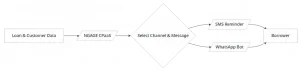
The irony? The data to make this timely outreach effective usually already exists in the bank’s systems (account status, customer preferences, payment history). What’s missing is the orchestration. Too many banks rely on rigid legacy workflows: an IT schedule or manual compliance calls. A true omnichannel communication platform would read a missed payment event in real time and instantly trigger the best outreach. For example, imagine the moment an EMI fails: the system sends a friendly WhatsApp or SMS (via an A2P messaging API) with a personalized message and a payment link. If there’s no response in a few hours, it escalates to voice or push notifications. Each touchpoint is logged and analytics updated. This is precisely the “right channel, right time, right message” approach. Comviva’s NGAGE offers this kind of smart orchestration. NGAGE is an AI-powered CPaaS platform supporting 130+ communication APIs. It can integrate with a bank’s CRM and collections platform to pull customer data (loan amount, due date, contact prefs) and feed it into the communication workflow. For instance, a missed EMI could automatically trigger an SMS API or WhatsApp Business API message stating, “Hi [Name], your payment of $X was due today. Need help? Reply or click [link] to pay online.” Because NGAGE supports rich messaging (even RCS and AI chatbots), the bank can include payment buttons or instantly offer assistance via a conversational interface. All interactions – replies, chat, clicks – are recorded and analyzed in real time, so the collections team knows exactly where each customer stands.
Behind the scenes, NGAGE handles the channel selection. It knows which customers respond to SMS, which prefer a quick call, and which engage on chat. It can throttle frequency and timing to avoid overcontact. By leveraging a unified CPaaS, banks minimize manual coordination and costly delays. Global research highlights this trend: CPaaS platforms in banking are increasingly used for personalized customer communications and reminders. In fact, a recent industry report notes that CPaaS delivers onboarding features and timely text reminders that “minimize the risk of delinquency”. In practice, that means more customers pay on time and fewer accounts need expensive collection efforts.
In summary, banks aren’t failing to collect because they lack data – they’re failing to act fast enough on the right channels. The first 48 hours after a missed payment are the golden window for outreach. With the right omnichannel strategy powered by NGAGE, financial institutions can automate immediate, personalized reminders and support. This closes the gap between “missed payment” and “payment received,” and it can make the difference between 30–40% success or letting those recoverable funds slip away.
Table: Traditional Stack vs NGAGE-Enabled Stack
Attribute |
Traditional Stack |
NGAGE-Enabled Stack |
|---|---|---|
| Identity
Resolution | CRM/CDP data in one system, comms in another; no real-time link | Customer data unified into message context |
| Channel
Orchestration | Separate tools per channel, no coordination | Single platform selects channels and IDs |
| Timing
Optimization | Batch sends or manual triggers, delays | Automated workflows send at the optimal time |
| Personalization | Generic blasts (“Hello Customer”) | Contextual messages using customer info |
| Analytics &
Attribution | Disconnected reporting by channel | Consolidated engagement analytics across channels |
| Monetization | No direct revenue from messaging | New revenue (A2P messaging, enhanced CX) |
Mermaid Flowchart (Collections Message Flow via NGAGE)</summary>